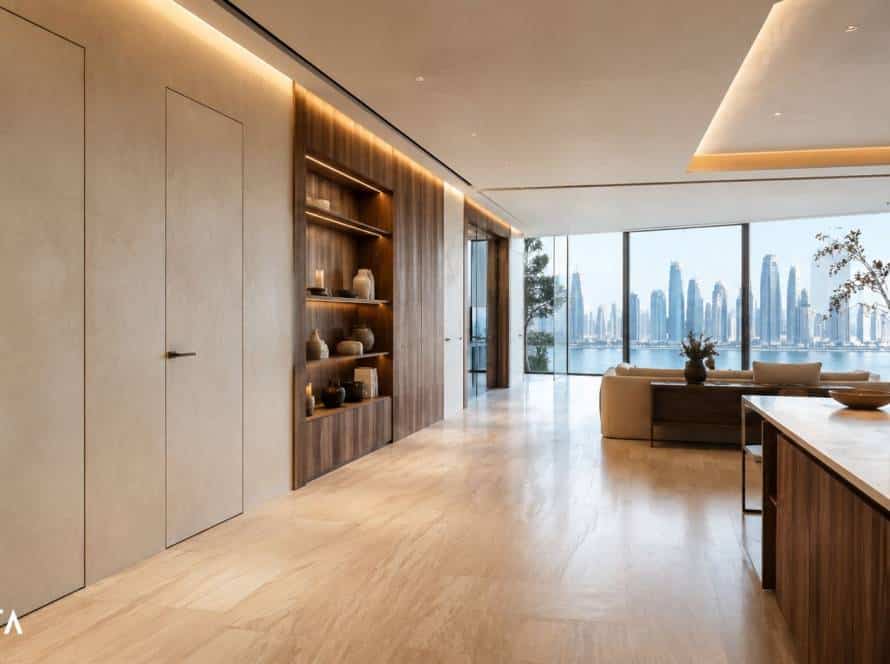


Importa Travertini Doors: The Ultimate Concealed System for Stone, Tile, and Heavy Architectural Finishes
Luxury interiors in the UAE are increasingly defined by materials rather than decoration. Natural stone, porcelain slabs, textured panels, and monolithic wall finishes are becoming central elements in modern architecture.
But integrating doors into these surfaces presents a major challenge.
Standard concealed doors are typically not engineered to support heavy cladding materials. Over time, this can lead to deformation, cracking, alignment issues, or visible inconsistencies.
This is where Importa Travertini introduces a different category of concealed door systems—one specifically engineered for heavy architectural finishes.
What Is Importa Travertini?
Direct Answer
Importa Travertini is a concealed flush door system designed for natural stone, ceramic tiles, porcelain slabs, and other heavy decorative wall finishes.
Detailed Explanation
Unlike conventional hidden doors designed only for paint or light coatings, Travertini is engineered to become part of the wall structure itself.
It follows the concept of material-first architecture, where:
The wall finish defines the space
The door visually disappears
The surface remains completely uninterrupted
The result is a seamless architectural composition where the door integrates naturally into the material language of the interior.
This approach is especially relevant in luxury villas, premium apartments, hospitality projects, and bespoke commercial interiors across the UAE.
What Makes Travertini Different from Standard Concealed Doors?
Direct Answer
Its structure is engineered specifically to support heavy cladding materials without compromising stability or alignment.
Detailed Explanation
Most hidden doors are not designed to carry the weight of stone or tile finishes.
Travertini addresses this through a specialized construction system that includes:
Full concealed aluminum frame
Aluminum door structure with protected edges
Fiber cement board core
-6 mm recessed surface for cladding integration
The recessed layer allows heavy finishes to sit flush with the surrounding wall.
This ensures:
No protrusion from the wall plane
Perfect alignment of materials
A true monolithic appearance
The system is available in:
Classic Silver
Royal Black
Timeless Gold
allowing integration into different architectural styles.
Why Is the -6 mm Recessed Door Leaf Important?
Direct Answer
Because it creates the required depth for stone, porcelain, and other thick finishes to align perfectly with the wall surface.
Detailed Explanation
Heavy architectural finishes require space.
Without a recessed system, applied materials can:
Extend beyond the wall plane
Create uneven transitions
Disrupt the minimalist appearance
Travertini’s -6 mm recessed door leaf is engineered specifically to accommodate:
Natural stone
Porcelain slabs
Ceramic tiles
Decorative architectural panels
This allows the finish to continue seamlessly across the entire wall—including the door itself.
Why Does Fiber Cement Matter in Heavy Cladding Applications?
Direct Answer
Because it provides the rigidity and stability needed to support heavy finishes long term.
Detailed Explanation
At the core of the Travertini system is fiber cement board—a material commonly used in high-performance façade systems.
Its properties make it ideal for architectural door applications.
Key Benefits Include:
Extreme Rigidity
Supports heavy materials without bending or deformation.
Crack Resistance
Helps prevent microcracks in stone or tile surfaces.
Moisture Resistance
Performs reliably in UAE humidity conditions.
Excellent Adhesion
Allows secure bonding of adhesives and cladding systems.
Long-Term Stability
Maintains geometry and alignment over time.
Unlike MDF, fiber cement is specifically engineered for mineral and structural finishes.
This is critical in projects where long-term precision matters.
Which Finishes Are Compatible with Travertini Doors?
Direct Answer
Natural stone, porcelain slabs, ceramic tiles, decorative panels, microcement systems, and soft cladding materials.
Detailed Explanation
Travertini is designed to support a wide variety of premium finishes, including:
Travertine
Marble
Granite
Large-format porcelain slabs
Ceramic tiles
Microcement panels
Leather and soft panels up to 5.5 mm thickness
An additional advantage is the ability to apply different finishes on each side of the door.
This provides greater design flexibility for complex interiors.
How Does the Aluminum Structure Improve Performance?
Direct Answer
It increases strength, dimensional stability, and climate resistance.
Detailed Explanation
The UAE climate places significant stress on interior systems due to:
Temperature fluctuations
Humidity variations
Intensive usage conditions
Travertini uses a full aluminum structural system to ensure long-term reliability.
Advantages include:
Resistance to warping
Improved structural integrity
Stable operation over time
Better performance with heavy cladding materials
This makes the system suitable for both residential and commercial applications.
What Hardware Solutions Are Integrated into the System?
Direct Answer
Concealed hinges, magnetic locks, and premium hidden hardware maintain the clean architectural appearance.
Detailed Explanation
Travertini integrates advanced concealed hardware systems, including:
3D adjustable concealed hinges
Magnetic soft-closing locks
Hidden threshold options
Premium handle integrations
Optional acoustic solutions
All elements are designed to remain visually minimal while ensuring smooth operation.
Where Are Travertini Doors Most Commonly Used?
Direct Answer
In luxury and architecture-driven projects where material continuity is essential.
Detailed Explanation
Travertini is ideal for:
Luxury Villas
Stone and slab finishes continue seamlessly through spaces.
Premium Apartments
Minimalist interiors benefit from uninterrupted surfaces.
Hospitality Projects
Hotels and lounges achieve a refined architectural atmosphere.
Bespoke Commercial Interiors
High-end offices and showrooms use integrated wall systems to create a premium experience.
This system is especially suited for:
Contemporary minimalism
Modern Italian-inspired interiors
Material-focused architecture
Common Mistakes to Avoid with Heavy Cladding Door Systems
Even premium systems require correct planning and execution.
Using Standard Hidden Doors for Stone Finishes
Most standard systems are not engineered for heavy materials.
Ignoring Wall Alignment
Perfect wall leveling is essential for flush integration.
Exceeding Recommended Cladding Thickness
Overloading the system can affect performance.
Poor Installation Coordination
Heavy finish systems require professional installation and precise sequencing.
Avoiding these mistakes ensures both visual and technical success.
Why Is Travertini Relevant for UAE Luxury Interiors?
Direct Answer
Because UAE luxury projects increasingly prioritize material continuity, minimalist detailing, and long-term durability.
Detailed Explanation
High-end interiors in Dubai and Abu Dhabi are moving toward:
Monolithic wall surfaces
Large-format stone applications
Seamless architectural detailing
Travertini supports these trends while also addressing practical requirements such as:
Climate resistance
Structural reliability
Finish durability
This combination of aesthetics and engineering makes it highly relevant for the regional market.
Final Thoughts
Modern luxury interiors demand more than beautiful materials.
They require systems capable of integrating those materials seamlessly and reliably.
Importa Travertini was developed precisely for this purpose.
By combining aluminum engineering, fiber cement technology, and recessed cladding integration, it allows doors to disappear into stone, porcelain, and architectural surfaces without compromising performance.
For developers and contractors in the UAE, this is more than a design feature.
It is a technical solution that enables true architectural continuity—where materials, surfaces, and functionality work together as one unified system.
FAQ
What are the main types of openings in Importa doors?
There are traditional hinged doors, hidden concealed doors, interior sliding doors, exterior sliding doors, pivot doors, folding doors, flush-wall doors. rotating internal and external Importa doors.
What type of interior doors do you produce in the UAE?
Importa produce in the UAE interior internal and external doors with different materials of surfaces. We produce in UAEprimed doors, painted doors in color of walls, doors with hpl panels in texture of stones, doors with veneer and texture of best european wood, doors with solid wood panels, doors with coloured glass, doors with mirrors as you wish. For more info call or WhatsApp us.
What is the price of Dubai doors Importa ?
The price of Dubai doors Imports depends on the sizes of doors, type of opening of doors and material of door surfaces and starts from 3600 AED. Contact us to get a quotation.
What doors company is in Dubai? What doors manufacturer is in UAE?
Importa doors company is in Dubai. Importa company whose specialization is doors production in the United Arab Emirates.