

Quiet luxury is not a product category. It is a way of putting an interior together.
The idea is simple: the space should feel refined because the materials, proportions and details are well resolved, not because the room contains more expensive-looking objects.
For Importa managers, this is particularly relevant when a client or designer wants the doors to become part of the architecture rather than stand apart from it.
A quieter visual language
Quiet luxury interiors usually rely on a controlled palette and a small number of strong materials.
Natural wood, stone, textured surfaces, glass, mirror and carefully selected metal details can create enough character on their own. The room does not need multiple decorative features competing for attention.
The door becomes part of this visual discipline.
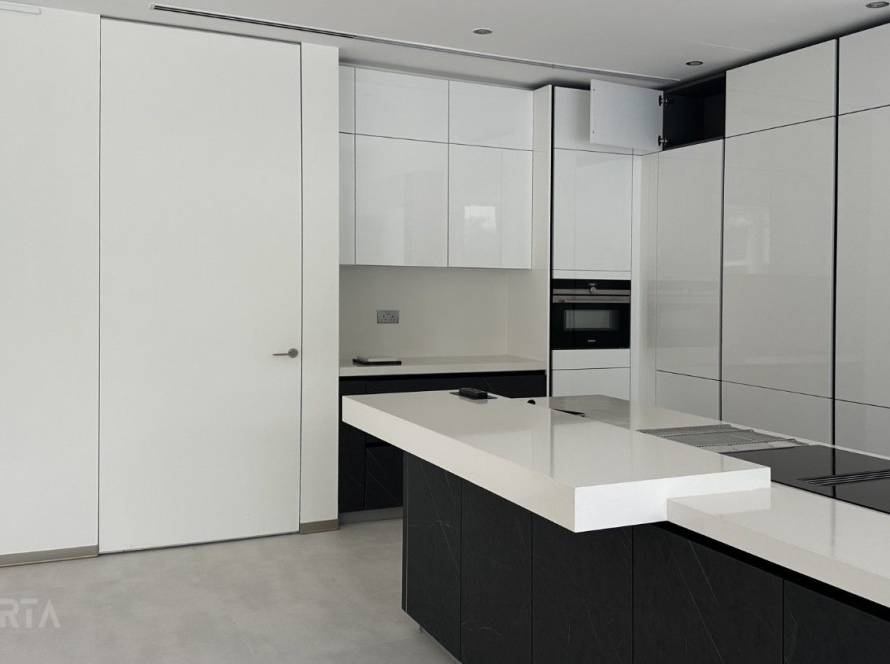
A concealed door can sit flush with the wall and carry the same finish, allowing the architectural surface to continue without a conventional frame or architrave.
Importa’s concealed-door portfolio is designed around this principle, with aluminum frames and door structures and a choice of finishes including painted surfaces, HPL, veneer, mirror and glass.
Material selection comes before the final door specification
When discussing a luxury project, the first useful question is often not “Which door?”
It is “What should the finished wall look like?”
The answer can immediately narrow the appropriate system.
A painted wall may call for a primed or coloured surface. A timber interior may require veneer. A wardrobe or dressing area may benefit from a mirror surface. A contemporary feature wall might use HPL or glass.
Importa’s current catalogue includes multiple concealed and sliding configurations that can be customized in dimensions, finishes and opening arrangements.
Veneer and HPL create different impressions
Veneer brings natural variation into an interior.
Because it is made from thin sheets of real wood, the grain, colour and figure contribute to the character of the finished surface. It works particularly well when a designer wants warmth without introducing additional decoration.
HPL has a different role.
It is a dense decorative laminate available in a wide range of designs and textures. Depending on the selected grade, it can provide practical properties including resistance to water, chemicals, fire and scratching.
For a manager, the distinction is useful: veneer is often selected for natural material character, while HPL offers broader decorative and practical flexibility.
Stone and specialty finishes need dedicated systems
Quiet luxury projects often use stone, microcement, Venetian stucco or textured plaster across large surfaces.
These finishes cannot simply be treated as decorative additions to a standard door.
Importa’s Concretto system has a recessed surface of up to 2 mm for Venetian stucco, microcement, textured plaster and specialty wall materials. The intention is to create a continuous finished plane between the wall and door.
For heavier architectural surfaces, Travertini provides a recessed surface of up to 6 mm for natural stone, ceramic tiles and exclusive cladding panels. Its fiber cement board backing is intended to provide a suitable bonding base for these finishes.
This is an important specification point: the final finish thickness needs to be known before the door system is selected.
The structure behind the luxury finish
A seamless appearance depends on more than the visible surface.
Importa’s concealed hinged doors use an anodized aluminum frame and aluminum door leaf, concealed 3D hinges, reinforced cross support and different surface options. The system also includes features such as acoustic and thermal insulation, a silent magnetic lock system and perimeter sealing.
The aluminum construction is one of the key points managers should understand.
Importa’s product information identifies aluminum as the primary frame and internal door material and positions the construction for warm climatic zones, with resistance to water and moisture compared with conventional wooden or MDF alternatives.
For UAE projects, the construction should therefore be discussed alongside the appearance.
Precision is part of the design
In a conventional door, a small visual inconsistency may be hidden by an architrave.
In a concealed door, it is much easier to see.
The relationship between the door leaf, wall, floor, ceiling and adjacent panels needs to be considered as one composition. The concealed 3D hinges allow adjustment in three dimensions, helping achieve accurate positioning and smooth operation.
This is why concealed doors should not be treated as a late-stage finishing item.
The opening, wall build-up and final surface need to be coordinated before installation.
Quiet luxury does not mean every door should disappear
A common misunderstanding is that a luxury interior must hide every door.
Not necessarily.
A door can deliberately become a feature when the architecture calls for it. A pivot door, coloured glass door or carefully selected veneer can provide a visual focal point.
Quiet luxury is about control.
Some doors disappear. Others are allowed to contribute to the composition. The important thing is that the decision is intentional.
Importa’s portfolio includes concealed hinged, sliding, pocket, magic sliding and pivot configurations, giving designers different approaches depending on the space and desired architectural effect.
Common points to check with a client
Before preparing a quotation for a quiet-luxury project, confirm the design information rather than relying on a general request for a “hidden door.”
Check:
Opening dimensions
Wall thickness
Finished floor level
Opening direction
Hinged, sliding or pivot configuration
Surface material
Final surface thickness
Finish on one or both sides
Required door height
Hardware requirements
Acoustic or sealing requirements
Importa’s client communication guidance also recommends obtaining drawings, opening dimensions and finishing information before preparing a quotation.
Mistakes that can compromise the result
One of the most common problems is selecting the finish first and discussing the door system later.
Another is assuming that every concealed door can accept every type of cladding.
Heavy materials, specialty plaster and other architectural finishes require the appropriate door construction and recessed depth.
It is also worth avoiding the temptation to over-design. If the client already has beautiful stone, timber and lighting, adding another decorative material may reduce rather than improve the overall effect.
The Importa perspective
The strongest quiet-luxury projects are rarely about one spectacular product.
They depend on coordination between the architecture, materials and functional elements.
For Importa, the concealed door is one part of that larger composition. The aluminum structure provides the foundation, while the selected surface determines how the door participates visually in the room.
That is the conversation managers should be prepared to have with clients.
Not simply: “Do you want a hidden door?”
But rather: “What do you want the wall to become?”
Once that is clear, the right door configuration and finish become much easier to identify.