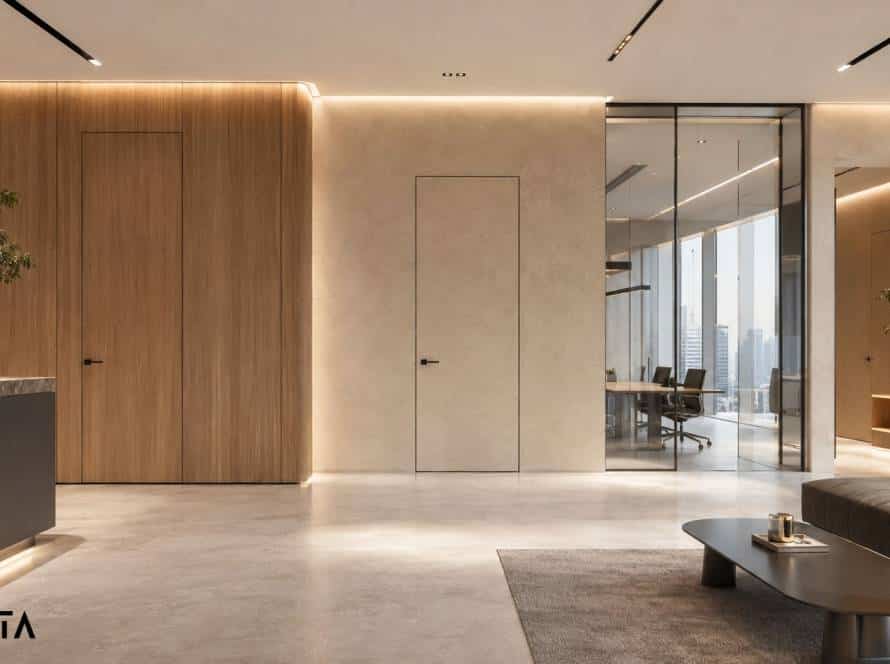


Modern interior design is increasingly defined by seamless surfaces, integrated materials, and architectural precision. In luxury villas, premium apartments, hospitality projects, and executive offices across the UAE, walls are no longer simple partitions—they are design features in their own right.
Architects now specify microcement, decorative plaster, porcelain slabs, natural stone, and other high-end finishes to create sophisticated interior environments. However, the long-term success of these finishes depends on something many project teams overlook during the planning stage: the door system behind them.
At Importa, concealed door systems are engineered not only to look elegant but also to protect the integrity of surrounding wall finishes for years to come.
For developers and contractors, understanding this connection is essential for reducing maintenance issues and delivering premium-quality interiors that perform as beautifully as they look.
Why Do Wall Finishes Fail Around Doors?
Direct Answer
Many wall finish defects originate from structural movement, poor substrate selection, or unstable door systems rather than from the finish itself.
Detailed Explanation
The finish is frequently held initially when surface flaws or fractures develop around doors.
In actuality, the underlying cause is often concealed beneath the surface.
Door openings experience constant activity throughout a building’s life cycle. Every opening and closing motion creates small forces that affect adjacent materials.
If the door system lacks rigidity or dimensional stability, these forces can transfer directly into the surrounding wall finish.
Over time, this may lead to:
Hairline cracking
Surface separation
Visible joints
Edge deterioration
Uneven wall transitions
In luxury interiors where every detail matters, even minor imperfections can affect the overall perception of quality.
Why Does Importa Focus on Structural Stability?
Direct Answer
Because long-term finish performance depends on maintaining precise geometry throughout the life of the installation.
Detailed Explanation
Many conventional door systems are designed primarily for functionality.
Importa systems are designed as architectural components.
This means every concealed frame, door leaf, and installation detail is engineered to maintain alignment and stability over time.
The objective is simple:
Long after the project is finished, the wall and the door should continue to function as a single architectural surface.
This philosophy becomes especially important in premium developments where decorative finishes are expected to remain flawless for many years.
How Does Aluminum Construction Improve Interior Durability?
Direct Answer
Aluminum provides superior dimensional stability compared to many traditional construction materials.
Detailed Explanation
Climate conditions in the UAE create unique challenges for interior systems.
Projects are exposed to:
High ambient temperatures
Continuous air conditioning
Humidity fluctuations
Seasonal environmental changes
These factors can affect material performance significantly.
Importa concealed frames utilize aluminum because it offers:
Exceptional Stability
Aluminum maintains its shape even under demanding environmental conditions.
Precision Alignment
Manufactured tolerances remain consistent over time.
Corrosion Resistance
Particularly important in coastal regions and humid environments.
Long Service Life
The material is engineered for durability and repeated daily use.
For developers, this translates into fewer future alignment issues and reduced maintenance requirements.
Why Are Modern Decorative Finishes More Demanding?
Direct Answer
Contemporary finishes require stronger and more stable support systems than traditional wall treatments.
Detailed Explanation
Luxury interiors increasingly feature materials that were once reserved for architectural feature walls.
These include:
Microcement
Venetian plaster
Natural stone
Large-format porcelain
Textured decorative coatings
While visually impressive, these materials are less forgiving than conventional paint finishes.
They require:
Stable substrates
Accurate installation
Consistent structural support
Without these conditions, even premium finishes can experience premature deterioration.
This is why Importa systems are designed to work in harmony with modern architectural materials.
How Do Importa Concealed Doors Support Seamless Wall Concepts?
Direct Answer
They allow decorative finishes to continue across the door surface while maintaining structural reliability.
Detailed Explanation
One of the defining characteristics of contemporary luxury interiors is visual continuity.
Architects increasingly seek to eliminate unnecessary interruptions within wall compositions.
Importa concealed doors contribute to this goal by:
Removing visible frames
Eliminating decorative architraves
Supporting flush integration
Preserving clean architectural lines
The result is a more unified and sophisticated environment.
More importantly, the concealed system provides the structural foundation needed to preserve this appearance over time.
Why Is Surface Compatibility Important?
Direct Answer
Modern ornamental finishes are not appropriate for all door surfaces.
Detailed Explanation
The quality of the visible finish depends heavily on the substrate beneath it.
Certain materials may struggle with:
Adhesion issues
Surface movement
Moisture sensitivity
Long-term cracking
Importa solutions are developed with finish compatibility in mind.
This allows architects and contractors to specify a wide range of premium finishes while maintaining confidence in long-term performance.
Whether the project involves decorative plaster, microcement, paint, or cladding systems, the underlying structure must support the finish properly.
What Problems Can Contractors Avoid by Selecting the Right Door System Early?
Direct Answer
Early specification helps prevent costly corrections, delays, and post-handover maintenance issues.
Detailed Explanation
Door systems are often treated as finishing elements.
In reality, they influence multiple stages of construction.
Early planning allows project teams to coordinate:
Wall Construction
Ensuring correct structural preparation.
Finishing Thickness
Maintaining flush transitions between materials.
Hardware Integration
Preventing conflicts during installation.
Technical Coordination
Aligning architectural, mechanical, and finishing requirements.
This proactive approach reduces risk throughout the project.
How Do Importa Systems Contribute to Long-Term Property Value?
Direct Answer
They help preserve interior quality, reduce maintenance requirements, and enhance the perception of craftsmanship.
Detailed Explanation
Property value is influenced by more than appearance on handover day.
Long-term performance plays an equally important role.
When interiors maintain their quality over time, owners benefit from:
Lower maintenance costs
Reduced refurbishment requirements
Better occupant satisfaction
Stronger asset value
Architectural details that remain stable and visually consistent reinforce the perception of premium construction.
For developers, this supports both brand reputation and customer confidence.
Common Mistakes That Affect Finish Longevity
When technical aspects are neglected, even well-designed interiors might have issues.
Treating Doors as Standalone Products
Doors should be considered part of the architectural wall system.
Selecting Systems Based Only on Initial Cost
Lower-cost solutions may result in significantly higher maintenance expenses later.
Ignoring Environmental Conditions
Materials must be suitable for UAE climate conditions.
Delaying Door Specification
Late decisions often create coordination challenges.
Underestimating Installation Accuracy
Precision is essential for flush systems and premium finishes.
Avoiding these mistakes improves project outcomes significantly.
Practical Advice for Developers and Contractors
To maximize wall finish performance and interior longevity:
Specify Concealed Systems During Design Development
Early integration improves coordination and finish quality.
Prioritize Structural Stability
Choose systems engineered for long-term alignment.
Consider Finish Requirements
Different materials demand different performance characteristics.
Focus on Lifecycle Value
Evaluate maintenance costs, not just installation costs.
Work With Specialized Architectural System Providers
Technical expertise can prevent expensive future issues.
The Future of Durable Interior Design
Luxury interiors are becoming increasingly seamless, material-driven, and technically sophisticated.
As architectural standards continue to rise across the UAE and GCC, the relationship between concealed systems and finish performance will become even more important.
Developers are no longer selecting door systems based solely on appearance.
They are looking for solutions that support long-term quality, protect investment value, and reduce future maintenance concerns.
This shift reflects a broader industry movement toward performance-based design.
Final Thoughts
Wall finishes may be the most visible part of an interior, but their longevity depends on what lies beneath them.
A high-quality finish can only perform as well as the system supporting it.
Importa concealed door solutions are engineered to provide the structural stability, precision, and compatibility required by modern luxury interiors.
By protecting wall finishes, maintaining alignment, and supporting seamless architectural concepts, Importa systems help developers and contractors deliver interiors that continue to perform long after construction is complete.
In premium architecture, durability is not achieved by the finish alone.
It begins with the system behind it.
FAQ
What are the main types of openings in Importa doors?
There are traditional hinged doors, hidden concealed doors, interior sliding doors, exterior sliding doors, pivot doors, folding doors, flush-wall doors. rotating internal and external Importa doors.
What type of interior doors do you produce in the UAE?
Importa produce in the UAE interior internal and external doors with different materials of surfaces. We produce in UAEprimed doors, painted doors in color of walls, doors with hpl panels in texture of stones, doors with veneer and texture of best european wood, doors with solid wood panels, doors with coloured glass, doors with mirrors as you wish. For more info call or WhatsApp us.
What is the price of Dubai doors Importa ?
The price of Dubai doors Imports depends on the sizes of doors, type of opening of doors and material of door surfaces and starts from 3600 AED. Contact us to get a quotation.
What doors company is in Dubai? What doors manufacturer is in UAE?
Importa doors company is in Dubai. Importa company whose specialization is doors production in the United Arab Emirates.