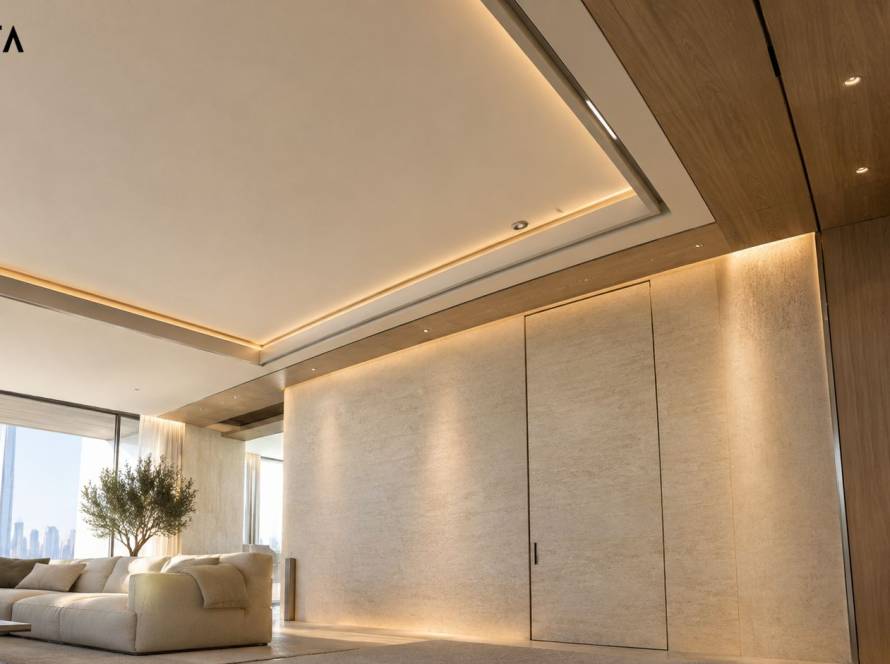


Interior design is becoming quieter, but that does not mean it is becoming less interesting.
Instead of relying on many decorative elements, contemporary luxury spaces are increasingly built around the character of the materials themselves. Wood grain, stone, plaster, glass, metal and textured surfaces provide the visual depth.
For an Importa manager, this is an important shift to understand because the door is often part of that material composition.
From decoration to material character
A material-rich interior does not necessarily use many materials.
The stronger approach is usually to select a few finishes and allow them to carry the design. A natural veneer can bring warmth. Stone can introduce weight and permanence. Microcement can create a continuous architectural surface. Glass and mirror can add reflection without requiring additional decoration.
The door should be considered within this composition.
A standard visible door can interrupt an otherwise continuous wall. A concealed door gives the designer the option of continuing the same finish across the opening.
This is one of the central ideas behind Importa’s concealed-door systems.
The surface often defines the door
Importa concealed doors can be finished in several different ways, including painted surfaces, HPL, natural veneer, mirror and coloured glass. The company’s product information also includes systems designed for decorative plaster, microcement, natural stone, ceramic tiles and other cladding materials.
This gives managers an important starting point when speaking with a client:
Do not begin with the door alone. Begin with the finish the client wants to achieve.
A client may say they want a “hidden door,” but what they are really trying to achieve may be a continuous wood wall, a stone feature, a minimalist painted surface or a textured plaster finish.
The appropriate Importa system depends partly on that final material.
HPL: practical texture and design flexibility
HPL is one of the more versatile choices for projects that require a decorative surface with a broad range of designs.
Importa’s catalogue describes HPL as a dense, hard and form-retaining material produced from multiple layers compressed under high pressure. It is available in different designs and textures and can offer properties such as water, chemical, fire and scratch resistance depending on the specification.
For managers, the useful point is not simply that HPL is “durable.”
The more relevant question is whether the selected HPL gives the project the required visual character and practical performance.
It can work particularly well when the door needs to visually continue a wall panel or joinery scheme.
Veneer brings natural variation
Veneer works differently.
Natural wood has variation in colour, grain and figure. That variation is part of its appeal and is often exactly what gives a luxury interior warmth without adding decorative clutter.
Importa offers natural wood veneer as one of its concealed-door surfaces. The catalogue describes veneer as thin sheets of wood cut from a log and used for decorative applications.
When discussing veneer with a client, it is useful to set expectations around natural variation.
A large wall and door combination will not necessarily look identical to a small sample. Grain direction, lighting and the scale of the surface all influence the final appearance.
Mirror and glass change the atmosphere
Mirror is particularly useful when the objective is to make a door visually disappear while also extending a reflective surface.
Importa mirror doors use 6 mm mirror with an anti-traumatic film and can be produced with mirror surfaces on one or both sides.
Coloured glass offers a different expression.
Importa’s glass option uses tempered painted glass in RAL colours and incorporates an anti-traumatic film. The standard glass thickness is 6 mm.
These finishes can be particularly effective in contemporary residential interiors, wardrobes, feature walls and commercial environments where reflection or colour is part of the design language.
When the finish becomes part of the wall
Some of the most demanding material-rich interiors use finishes that need to continue directly across the door.
This is where the Concretto system becomes relevant.
Concretto has a 2 mm recessed finish designed for Venetian stucco, microcement, textured plaster and similar specialty wall materials. The recessed surface allows the finished door to sit flush with the surrounding wall.
The specification matters because decorative finishes are not simply visual layers. Their thickness and application method need to correspond with the door construction.
A manager should therefore confirm the intended finish before recommending a system.
Heavy materials require a different approach
Stone and ceramic finishes bring another level of consideration.
Importa’s Travertini system has a 6 mm recessed surface intended for natural stone, ceramic tiles and exclusive cladding panels. Its fiber cement board backing is designed to provide a suitable base for bonding these materials.
This is a useful distinction when dealing with architects and contractors.
A concealed door is not automatically suitable for every wall finish simply because the finish can be installed on a wall.
The door leaf, backing, recessed depth, adhesive system, weight and installation details need to be considered as one assembly.
The structure behind the finish still matters
Material-rich interiors put a lot of attention on the visible surface, but the construction behind it remains critical.
Importa uses aluminum for its concealed door frame and door structure. The technical catalogue identifies the anodized aluminum frame as providing strength, corrosion resistance and dimensional stability, while concealed 3D hinges allow precise adjustment of the door.
This is especially relevant in the UAE.
The company positions its aluminum construction as suitable for warm climatic zones and resistant to water and moisture compared with conventional wooden or MDF constructions.
The finish may create the visual identity, but the underlying structure helps determine whether that visual identity can remain stable over time.
What to clarify before quoting
When a client requests a concealed door with a specific material finish, collect the technical information before discussing the final quotation.
At minimum, clarify:
Door opening dimensions
Finished wall thickness
Inside or outside opening
Hinged, sliding or pivot configuration
Selected surface
Actual finish or cladding thickness
Whether the same material continues onto both sides
Required height
Project location and application
Any special acoustic, closing or hardware requirements
Importa’s client communication process specifically calls for project information, drawings and opening dimensions when preparing quotations.
This is more than administrative detail. It helps prevent recommending a visually suitable system that is technically unsuitable for the project.
A useful way to explain the concept to clients
When speaking with a client, avoid making the conversation overly technical at the beginning.
Start with the visual intention.
If the client wants a continuous stone wall, explain that the door system needs to accommodate the stone. If they want microcement across the wall and door, discuss the recessed finish designed for that application. If they want a warm timber wall, discuss veneer and the overall composition.
Then move into the technical details.
This makes the product easier to understand because the technical specification is connected to something the client can actually see.
The main idea to remember
Material-rich interiors are not about adding more.
They are about giving selected materials enough space to be appreciated.
For Importa, this creates an opportunity to position the concealed door as part of the architectural finish rather than as an isolated product. The aluminum structure, concealed hardware and available surface systems work behind the final visual layer, allowing the designer to decide what the door should look like within the room.
The best result is often the one where the material gets all the attention and the door itself quietly does its job.