

There is a noticeable change happening in luxury residential interiors.
The idea of luxury is becoming less about adding another decorative feature and more about creating a space where everything feels considered. Walls are cleaner, materials are more continuous, lighting is integrated, and functional elements are becoming less visually dominant.
This is where the idea of invisible architecture becomes interesting.
A door is still needed. Storage is still needed. Access between rooms is still needed. The difference is that these functional elements no longer have to announce themselves.
For Importa, this is the point at which the design of concealed doors becomes an integral aspect of the architecture rather than just a component of the furniture or woodwork.
Luxury Design Is Becoming Quieter
The most successful high-end interiors often do not immediately reveal how much work went into them.
A large stone wall may appear completely uninterrupted. A timber surface may continue from one section to another without an obvious break. A corridor may feel almost monolithic.
Then a section of that wall opens.
That moment is one of the defining characteristics of invisible architecture. The function is there, but the visual language remains controlled.
This approach works particularly well in UAE villas and premium residences, where architects frequently work with generous wall surfaces, natural stone, veneer, microcement, decorative plaster, glass, and other high-quality materials.
The Wall Includes a Concealed Door
The interaction between the door and the wall is one of the main distinctions between a disguised architectural door and a traditional door.
A traditional door usually announces itself through a frame, architrave, or contrasting finish.
With a concealed system, the intention is different. Together, the door leaf, frame, finish, hardware, and wall are taken into account.
The flush-to-wall frame and hidden hinges of Importa’s concealed hinged doors. The company’s aluminum door structure is designed to provide strength and dimensional stability while maintaining the clean appearance expected from a concealed system.
This is particularly valuable when the architect wants a wall to read as one continuous surface.
The Finish Can Make or Break the Effect
Invisible architecture is not achieved simply by hiding the hinges.
The surface matters just as much.
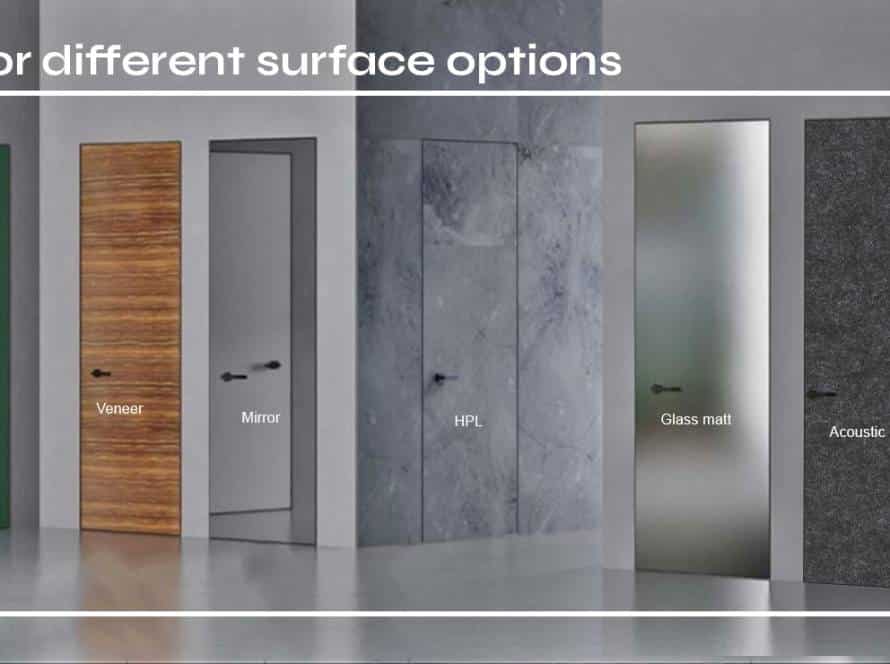
A variety of treatments, such as painted surfaces, HPL, veneer, mirror, and glass, can be specified for importa doors.
A painted door may blend in with the wall’s hue.
A timber composition can be continued with a veneer door.
A mirror surface can become part of a dressing room or extend the visual depth of a luxury interior. Importa’s mirror doors use 6 mm mirror with an anti-traumatic film and can be produced with mirror surfaces on one or both sides.
When the door is viewed as another architectural surface, the design options are significantly expanded.
Stone and Decorative Finishes Need a Different Approach
Some interiors demand more than paint or veneer.
Large-format stone, porcelain, decorative plaster, and microcement require the door construction to be considered together with the finish.
Importa’s Concretto system is designed around a 2 mm recessed surface for Venetian stucco, microcement, textured plaster, and similar specialty wall materials. The finish can continue across the door while remaining flush with the surrounding wall thanks to the recessed feature.
Importa’s Travertini system employs a 6 mm recessed surface for natural stone, ceramic tiles, and premium cladding panels for heavier finishes. The purpose of its fiber cement board backing is to facilitate the bonding of these architectural treatments.
This is an important distinction for architects and contractors.
A beautiful finish cannot compensate for a door system that was never designed around that finish.
The UAE Climate Changes the Conversation
Luxury residential architecture in the UAE has its own practical requirements.
Materials are exposed to heat, humidity, strong air-conditioning cycles, and, depending on location, coastal conditions.
This is one reason Importa places particular emphasis on aluminum construction.
The company describes its concealed doors as using complete aluminum frames and aluminum internal structures, rather than relying on a conventional wooden structure with only aluminum edging. Importa positions this construction as suitable for GCC climatic conditions, with strength and stability being important considerations.
For a luxury home, this matters because the visual quality of the finish ultimately depends on the stability of what is underneath it.
The Details Are Almost Invisible—Until They Are Wrong
Perhaps the most significant practical lesson is this one.
When a door is deliberately designed to disappear, imperfections become more noticeable.
An uneven reveal, inconsistent alignment, poorly coordinated finish, or unsuitable hardware can immediately draw attention to the opening.
Importa’s concealed systems use adjustable 3D hinges, allowing the door position to be fine-tuned in three directions. Magnetic locking systems and other hidden hardware solutions are also part of the product line.
These details are not merely technical accessories.
They are part of achieving the finished architectural effect.
Invisible Does Not Mean Impractical
There is sometimes a misconception that a concealed door is primarily a visual feature.
In a well-designed system, the opposite should be true.
The door still needs to open smoothly, close properly, withstand regular use, and provide the required level of privacy and functionality.
Importa’s product range includes concealed hinged doors as well as sliding, pocket sliding, magic sliding, pivot, double-door, and movable-partition systems.
This enables the entrance configuration to be determined by the architectural concept.
A hidden hinged door could be advantageous for a small dressing room entry. A larger transition between living spaces may call for a sliding or pivot solution.
The Most Common Planning Mistake
The biggest mistake is leaving concealed doors until the end of the interior design process.
By that point, the wall thickness may already be established, finishes may have been selected, flooring may be complete, and other trades may already be working around the opening.
Concealed doors work best when they are discussed early.
Before production begins, architects and contractors should determine the opening dimensions, wall structure, finish, door operation, hardware, and installation requirements.
Importa’s project approach includes consultation, measurement, calculation, production, and installation, reflecting the importance of treating the door as a coordinated project element rather than a last-minute product selection.
Invisible Architecture Extends Beyond Doors
The same thinking can be applied to other elements of a luxury interior.
Importa’s architectural portfolio also includes movable partitions, concealed skirting, shadow-gap profiles, and other solutions intended to create cleaner transitions between architectural surfaces.
A concealed door paired with hidden skirting and a carefully detailed ceiling can create a very different visual result from simply installing a series of premium products independently.
The real effect comes from coordination.
A More Thoughtful Definition of Luxury
Invisible architecture is not about making a house look empty.
It is about deciding what deserves attention.
A dramatic stone surface can remain the focal point because the door does not compete with it. A timber wall can continue uninterrupted. A dressing room can remain private without requiring a visually dominant entrance.
For Importa, concealed doors sit directly within this philosophy.
The company combines aluminum construction, concealed hardware, customizable dimensions, multiple opening configurations, and a broad range of surface options to give architects and contractors greater control over how functional openings become part of the interior.
The future of luxury interiors may therefore be less about what is added to a room and more about what can be integrated into it.
The best invisible architecture does not make functionality disappear. It makes functionality feel like it was always part of the design.